
Sign up / sign in

Sign up / sign in
 EXPLORE
Please wait while loading the data

 StatsLocation
 EcuadorShareDive centers

51 min - 21 m
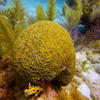
Wolf Island is larger than Darwin, and has several dive sites nearby. We stuck to two familiar ones: Landslide and Shark Bay. These, we were told, had the most abundance of marine life. Another nearby, called The Cave, was an easy dive but harbored less sea life. The other was at Elephant Rock and could be quite challenging, without much chance of reward that we wouldn't otherwise get at the first two sites. Thus, we stayed put for our last two dives at Wolf Island. I'm starting to pick out stone scorpionfish a little easier. At least they seem to be more abundant: perhaps a gentle reminder not to get too comfortable on the rocks. It's hard to get tired of seeing hammerheads and galapagos sharks, and even if you do, there are so many things to discover among the boulders. But this morning we wouldn't have to look long for something new: shortly into our dive a pod of dolphins swam by, out over the ledge. Too quick to follow or meet: they appeared to be on a mission to somewhere. Later, this or another pod swam back by in the opposite direction--mission accomplished, I presume. Underneath, I noticed a green coral of some sort, with stubby vase-like tubes fringed with pale green or yellow. Maybe I hadn't noticed them before, or maybe this time they struck me as something worth studying. Once you get over the shock and awe of nearby sharks and larger pelagic animals, you start to notice all sorts of creatures. Nonetheless, it was hard not to take notice of the abundance of hammerheads on this dive: perhaps the largest school we have seen to date swam by just below us. The temperature had dropped a few degrees and the water was clearer than when we were here two days ago. That may have been a factor in the presence of larger schools. During one of our first briefings, we were told about barracudas. I don't recall if I had seen any previously or not, but on this dive, as we swam out over the blue and away from the wall, I came upon a small school of them. I noticed they were largely different than the ones we commonly see back home and in the Caribbean. These were much smaller: two- to three-feet in length and over all had a less aggresive look to them. Like their cousins, they are long and slender, with long jaws, but did not expose their teeth as do the Atlantic variety. Later I learned that these are "pelican barracuda" (Sphyraena idiastes), indeed a different species than the more familiar great barracuda that I am used to seeing.

49 min - 30 m
Seas were calm this early in the morning: partly cloudy skies and cool. Hung out on the wall near the drop-off, first at around 90', settling at about 60' as we slowly scooted along the edge. Surge was not too strong; some anchored themselves to the rocks while I and others mainly hovered above swaying back-and-forth. Schools of scalloped hammerheads and galapagos sharks swam along the wall just below us, and over the deep a few yards away. A green sea turtle greeted us early in the dive, along with large schools of scissortail chromis and pacific creolefish. A pair of eagle rays and another single swam by a little further out off the wall. Several moray eels (mostly of the fine spotted variety) were among the rock crevices, as well as the other typical fish we have seen around Wolf Island: king angels, moorish idols, galapagos ringtail damselfish, parrotfish, wrasse--the sunset variety are particularly beautiful, hawkfish, mexican hogfish, goldrim surgeon fish, leather bass, butterfly fish, orangeside triggerfish, guineafowl puffers, trumpetfish, etc. Tucked away in the crevices were numerous urchins--spiny and pencil--and starfishes, and a few spiny lobsters. A school of razor surgeonfish skimmed along the top of the boulders, feeding along with an aggregate of other fish. Schools of jacks, bluefin trevally and other silvery fish hung out higher in the water column, over the edge. Later in the dive, the hammerheads swam closer to us, making wide circles swimming below, up the wall, and back over us.

51 min - 23 m
Back at Landslide, we were hoping to encounter another whale shark. So much in fact, we only settled on the ledge for a few minutes before Paulo decided our best chance would be out over the blue, a twenty or so yards away from the wall. On the ledge we saw several green turtles and fine spotted morays, and then swam through schools of creole fish and jacks out over the blue water. A lot of hammerheads were scattered about, as well as galapagos sharks, but no whale shark showed itself. In short order, our time was up and we headed to the surface and to dinner. We would have two more chances to spot whale sharks here in the morning before taking the 2 1/2 hour ride over to Darwin Island.

38 min - 27 m
Wolf Island juts up out of the water with shear cliffs all around, and no good place to step ashore even if we were allowed to do so. The cliffs where we were anchored were 100m high and rimmed with cacti and scrubby trees. From our excursion onshore a few days ago, it was apparent that most of these islands were dry. The northern ones even more so, and the leaves had already shed even this early into the season. Thousands of birds were strewn throughout the rockly cliff and trees on the crown. This island wasn't flat: it was obviously volcanic in origin, with peaks at the center reaching 250m in height. The shear remoteness of it and Darwin Island alone is enough to make one wonder how anything could survive in such a barren landscape. But the animals seem to thrive by the thousands, and underwater is no different. On the eastern side of the island, near Shark Bay, one area of the cliff gave way and a landslide ensued, tumbling large boulders into the sea and down to a ledge 80 feet deep, before the island gave way again into the blue. Here is where the "Landslide" site is located, and here we dove down to 80 feet, anchoring into the rocks and peering over the ledge. The site is very similar to Shark Bay, except the landslide itself made the wall less dramatic in its slope. Since I was very young, I have been fascinated by hammerhead sharks. I'm not sure why: maybe it's the funny-shaped head, or maybe it was just different from the great white all of the other kids loved--this was the era of Jaws. At any rate, it has always been a dream of mine to dive in the midst of these beasts, and today would be my chance! I looked at Jen, and she knew right-away what I was about to do. I paused at the 70' ledge for a moment, then kicked off over the blue, and descended down into the school of sharks. At 90' I stopped and filmed, and watched in awe as the sharks swam up and around me; dozens of them. Still, even being removed from the others, they seemed skiddish and would hurry around me whenever I breathed: they really don't like the bubbles! I didn't stay down for too long, though: I was already one of the first ones out due to air consumption on most dives, and I wanted to hang out longer in the event that something bigger came along. On the ledge, I saw several moray eels, green turtles, and the typical aggregates of schooling fish, angels, etc. Back topside, we prepared for lunch before the afternoon to try our luck again at Shark Bay.
 |
 |
 |
Status:
Read: /
Join with social media
OR
Join with email
When you register to join our site you are also signing up to receive emails from Diveboard for all your travel inspiration, tips and exclusive offers.
Already have an account? Sign in

Log in with social media
OR
Don't have an account yet? Sign up
Find your password? Sign in


 2017-05-05 : SSI Century Diver
 We are participating today in the startup contest Techcrunch Disrupt. Support Diveboard by voting for us!


