


Community
Share your thoughts, experiences or questions and participate in discussions over our favorite topic : SCUBA diving!
Posts by:

 Annotera

Text Annotation and Content Moderation for Social Media AI Systems
by Annotera on May 13, 2026
Social media platforms generate enormous volumes of user-generated content every second. From text posts and comments to hashtags, captions, and private messages, platforms must continuously monitor interactions to maintain safe and trustworthy digital environments. As artificial intelligence becomes central to platform governance, accurate text annotation and scalable content moderation are now essential pillars of modern social media AI systems.
At Annotera, we help organizations build reliable moderation frameworks through high-quality annotation services tailored for AI-driven social media ecosystems. By combining human expertise with scalable workflows, our teams support businesses...
Reducing AI Training Costs with Professional Video Annotation Services
by Annotera on April 14, 2026
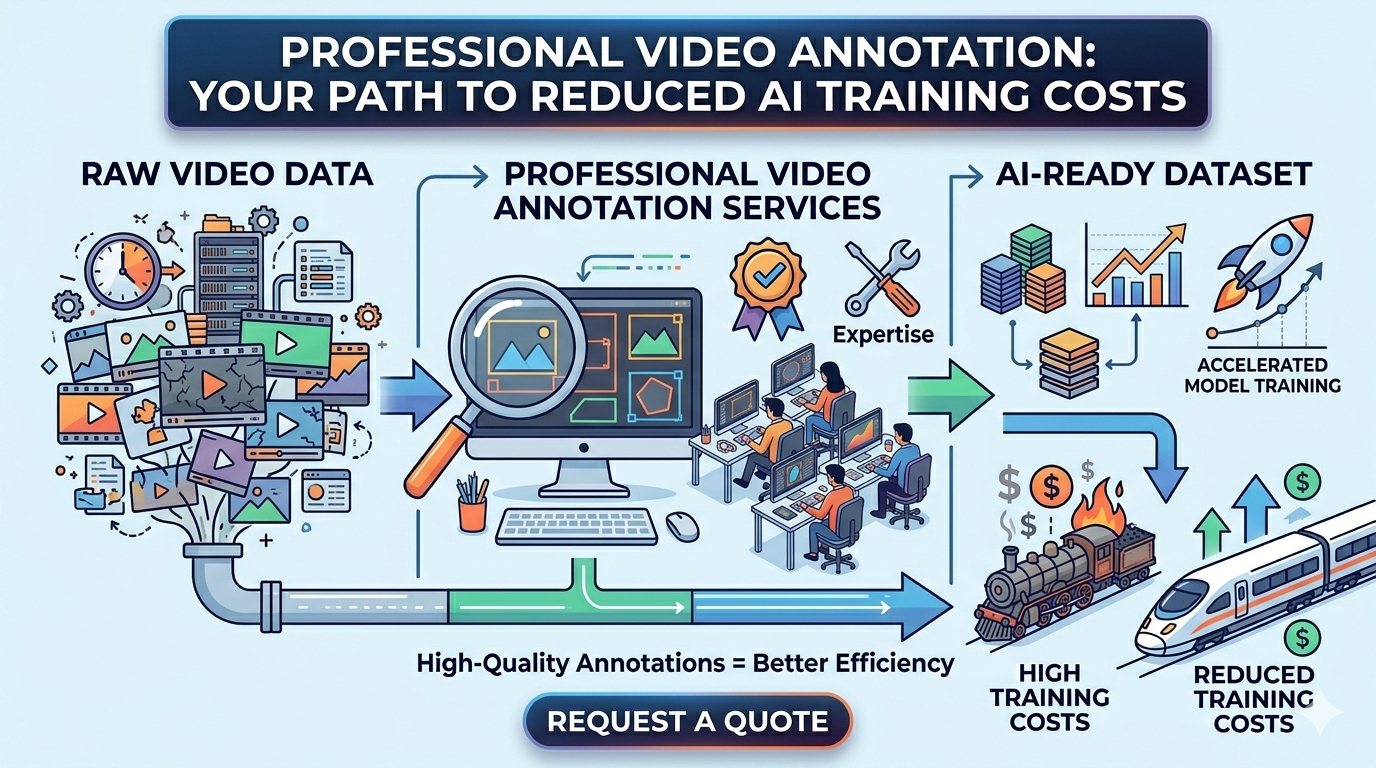
In today’s competitive AI landscape, businesses are under constant pressure to develop intelligent systems faster while keeping operational expenses under control. From autonomous vehicles and retail analytics to healthcare monitoring and security surveillance, video-based AI models are becoming central to innovation. However, one of the most significant and often underestimated cost drivers in AI development is high-quality training data preparation. This is where professional video annotation services play a transformative role.
At Annotera, we understand that the success of any video-based AI model depends heavily on the quality, consistency, and scalability of its labeled datasets....
Difference Between Landmark Annotation and Bounding Box Annotation
by Annotera on March 23, 2026
In the rapidly evolving landscape of artificial intelligence and computer vision, data annotation plays a pivotal role in determining model performance and reliability. Whether it’s enabling facial recognition systems, improving autonomous driving, or powering retail analytics, annotated data forms the backbone of intelligent systems. As a leading data annotation company, Annotera recognizes that selecting the right annotation technique is critical to achieving accurate and scalable AI outcomes.
Among the many annotation methods available today, landmark annotation and bounding box annotation are two widely used techniques in image labeling. While both are essential for training machine...
Annotating Data for Retrieval-Augmented Generation (RAG) Systems
by Annotera on February 03, 2026
Retrieval-Augmented Generation (RAG) systems combine a retrieval component (searching a corpus for relevant documents) with a generative model that composes answers using retrieved context. RAG architectures unlock factuality, up-to-date responses, and domain grounding, but they are only as reliable as the data they retrieve and the labels that guide retrieval behavior. At Annotera, we’ve observed that careful, disciplined annotation for both retrieval and generation stages is the difference between an experimental RAG prototype and a production-grade system. This article lays out pragmatic guidance for teams building RAG: what to annotate, how to annotate it, and the quality controls...
Active Learning and Data Annotation: Smarter Labeling at Scale
by Annotera on December 29, 2025
Scaling AI is rarely limited by algorithms anymore; it is limited by data. More specifically, it is limited by how quickly you can produce high-quality labels that reflect the real-world edge cases your model will face in production. Traditional labeling workflows treat annotation like a linear factory line: collect more data, label more data, train again. That approach works—until the volume explodes, budgets tighten, and the incremental value of labeling “more of the same” starts to collapse.
This is where active learning changes the economics of dataset creation. By prioritizing which examples to label next, active learning helps teams reduce redundant labeling, surface rare scenarios...
Share your experiences, thoughts, or ask a question |
| WRITE A POST |
Join Diveboard

 We are participating today in the startup contest Techcrunch Disrupt. Support Diveboard by voting for us!
























































































