


 Niall Forrester


 Thailand

-
Nº6
 Date: 2010-04-15 - 12:20
-
 Max Depth: 17.9m Duration: 40mins
Pictures

No pictures for this dive
- Temp: Surf 31°C Bottom 31°C
- Dive type : Recreational, Reef
- Visibility: Good Water: Salt
Specific gear used
- Wet suit: - 3mm Shortie
- Weights: 4.8 kg
Recent Divers in Hin Bida


Recent Pictures in Hin Bida
Dive Shop & Buddies
 Dive with Oisin (629292) from Blue Planet Divers
 Blue Planet Divers confirmed the dive with parameters: 17.9m / 40mins
 Dive buddies:
Christina Estrup

Link to this spot:
- Spot:
- Country:
- Area:
- Body of water:
Dive Profile
- 1. Air
- 15L Steel 200 → 50 bar
- Average depth: 11.9m
Data provided by EOL.org


Species Identified
Stegostoma fasciatum (Hermann, 1783) (zebra shark)
These sharks are mostly solitary but can occasionally be found in aggregations of 20 to 50 individuals . Believed to be a nocturnal hunter, they spend most of the day lazily swimming and resting on the bottom , becoming a...
Read More
Read More
Arothron nigropunctatus (Bloch & Schneider, 1801) (Blackspotted puffer)
Inhabit coastal to outer reef crest and slopes with rich invertebrate growth. Adults often in pairs . Feed on corals , crustaceans, mollusks, sponges, tunicates and algae . Generally common .
Gymnothorax isingteena (Richardson, 1845) (spotted moray)
Dendrochirus zebra (Cuvier, 1829) (Zebra turkeyfish)
Found on coral, rubble, or rock bottoms of reef flats ; also in coastal to outer reef habitats in sheltered lagoons and in caves, sometimes in small aggregations. Usually shallow, from 3-60m but also reported to 80 m dep...
Read More
Read More
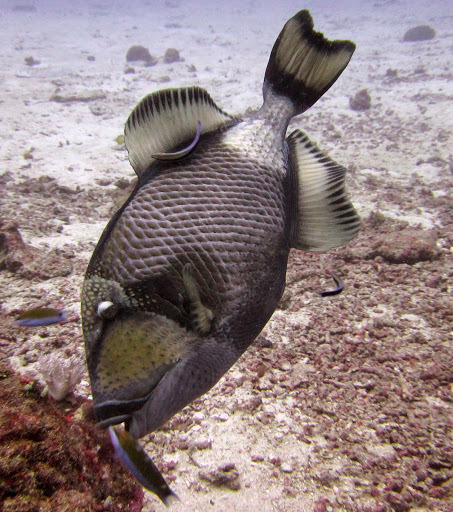
Balistoides viridescens (Bloch and Schneider, 1801) (Titan triggerfish)
Occur in lagoon, seaward reefs and sheltered inner reef slopes . Juveniles often associated with isolated patches of branching coral or rubble of shallow sandy protected areas. Adults occur singly or in pairs on the slo...
Read More
Read More
Share on Social Networks
- Facebook:

personalize your shared text as well as its destination (wall, page...) or send as a private message to a friend
- Twitter: Tweet personalize your tweet
- Google Plus:
Direct link to this dive
- Long link:
- Short link:


 We are participating today in the startup contest Techcrunch Disrupt. Support Diveboard by voting for us!
























































































Dive 2/2
Pressure groups calculated based on assumptions of maximum depth for whole dive. Large overestimation
(Profile is not accurate..)
Also Saw: Leopard Sharks (a.k.a Zebra)
Lionfish
Pufferfish & Giant Puffer Fish
Yellow-Speckled Moray
Titan Triggerfish