


 Smmcdonald


- SSI Century Diver (May 2017)
- SSI Advanced Open Water Diver (Nov 2014)
- SSI Specialty Course Wreck Diving (Nov 2014)
- SSI Specialty Course Deep Diving (Nov 2014)
- SSI Specialty Diver (Oct 2014)
- SSI Specialty Course Perfect Buoyancy (Sep 2014)
- SSI Specialty Course Navigation (Sep 2014)
- SSI Specialty Course Enriched Air Nitrox Level 2 (Sep 2014)
- SSI Open Water Diver (Aug 2014)
Places I've Dived
- Total number of dives not on diveboard:
This number is added to the total number of dives logged in Diveboard (public+private) for the stat "Total number of dives". - Dives published:221
- Total dives count:226
- Dives this year:0
- Total underwater time on Diveboard:6 days 11 hrs 51 min
- Most dives on Diveboard in:
United States - Deepest Dive:
52.3m in The Exumas, Bahamas - Longest Dive:
71 min in Key Largo, FL, United States - Pictures in logbook:712
- Number of species spotted:419
Favorite Pictures
Species Spotted
Data provided by EOL.org
BUser Feed
Smmcdonald's dives and posts rRSS feed
Favorite Dives
-

2018-06-15 Ecuador Darwin Island
Darwin's ArchDarwin Island arguably only has one dive site, and that is at Darwin Arch. (We can just assume from this point forward that we saw hammerheads and galapagos sharks on every dive.) Nonetheless, each dive here brought on a different experience. This time, we briefly settling in with the others along the ledge at 70'. I say "briefly" because we were soon up and swimming along with our first of many encounters of a whale shark on this dive. After first entering, Jen pointed out a scorpionfish. These were abundant, and not so much interesting to point out except this one happened to be in our path as we made are way across the boulders. (Later inspection of the video revealed that this may have been a player scorpionfish, but the video is too bad to tell for sure.) I had been wary of accidentally setting down on one of these and ruining my day, but so far we avoided the little landminds. Back to the whale sharks: about 5 minutes into our dive, and shortly after spotting the scorpionfish, Paulo's rattle engaged and I saw him pointing up. Near the surface swam a large whale shark, and soon I heard the tale-tell ascent warnings as everyone ascended to get a better look. (My dive profile, as it turns out, looks more like a heart rate monitor than the pretty flat lines found in the analogue charts.) For a short half-hour, we stayed relatively still as the shark swam figure-8s, approaching us 6 or 7 times during the dive. It turns out that our buddies noticed that this wasn't a single whale shark, but a pair that were swimming in the same path, but opposite of each other. The pair was apparent as one of them had a notch near the tail, and the other a scar on its underside. At any rate, after thinking our first dive-of-the-day could not be topped, I was finding out I was wrong. I had my closest encounter yet with a whale shark, as one threaded between me and a few other divers: totally spatially aware, she tilted to sideways as she swam by: one pectoral fin over me, the opposite under the diver directly on the other side. As soon as she cleared us, she glided back and moved effortlessly through our bubbles. As she went by, the water swept over me with a surprising amount of force from her tail. (We had been warned not to get to close, as an accidental *whack* could send us spinning through the water!) Each pass was as exhilarating as the one before; each time tempted to reach out just a few inches to feel their skin as they glide by. But all of us behaved and just took in the scene, and before we knew it our time was up. We ascended through a thick school of creolefish and jacks to our safety stop, where we were greeted again by one of the sharks. As I began to surface, I noticed a silky shark swimming tight circles around James, while everyone else in the group stayed their distance! I was about to film him when I noticed James already has his camera out, so I kept watching instead. Then the little guy darted toward James! I later kidded him that I was frantically reaching for my GoPro at that point so I could get the attack on video! But she apparently was more curious than hungry, and swam away shortly after. Back on the panga, Jen popped up shortly after I climbed on the boat, with one of the whale sharks directly below her. I yelled out at her to "look down!" and when she finally did, she said her fins were nearly touching. She popped back up wide-eyed and smiling. A great end to a perfect dive! This, indeed, is why we're here.
-
2015-06-05 United States Key Largo, FL
Uss Spiegel Grove (Lsd 32)Moored to port-side buoy near stern today (on crane). This is my first time exploring this part of the Spiegel Grove. The crane is like a grid of floating aquariums! There is so much marine life here: Large jacks met us at the base of the crane arm on the descent; angels, angels on the pillar, and other reef fish all along the crane arm. The marine life in this area alone was more than most of the reef dives I've done. We descended down to the deck and found the "throne", with which we had a bit of fun before swimming aft to explore the helipad area. It was here that Jen spotted the highlight of our dive--Two Goliath Groupers! The largest was at least 6' in length; the smaller about 2/3 the size of the larger. After watching them for a bit--and Jen swimming off to try and "catch" the smaller one--we swam back to the crane arm. I took more footage of the reef fish there, including a queen angelfish. Through the crane arm, I could clearly see the flag about 50 feet away. We finished the dive with a swim over the helipad toward the stern. I stayed at the back of the helipad while Joseph and Jen swam the remaining distance to the stern. We turned and swam back to the line, and ascended taking our PDIS and safety stop. SAC = 0.92 cf/min
-
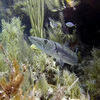
2015-06-04 United States Key Largo, FL
North North Dry RocksOne of my favorite reef dives to date, and definitely my longest bottom time! After practicing breathing techniques, Joseph and I stayed so that I could push the 1 hour mark before resurfacing. There are mooring balls here, but it is obvious that this reef isn't dived as often as others nearby (North Dry Rock and Dry Rocks where the Christ of the Abyss is located. The reef forms deep sand channels with a lot of marine life. Going over them again and again wore my ears out a bit. I filmed a lot, running out of battery power on a near-fully charged battery. At the end, when everyone else resurfaced, Joseph and I stuck around for another 20-15 minutes. That's when a lot of the fish came out of hiding! I swam slowly along the reef, and saw the most colorful queen angel I've ever seen, along with a 2-3 foot long Golden Tail Moray Eel (Gymnothorax miliaris). (Laurin had spotted a smaller moray eel earlier hiding out in the coral nearby.) Unfortunately, my battery had already run out by this time, so I didn't get any footage of it. Resurfaced a minute over our allotted time of 60 minutes, but no worries: Capt. Steve has been great this entire trip! And this out-of-the-way spot is one of the best! SAC = 0.82 cf/min
-
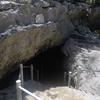
2015-08-07 Mexico Cenotes
Cenote Chak MoolIf our first Cenote dive experience was outstanding, this one was phenomenal! Elle decided that she would sit this one out, and it was probably a good call on her part. A bit darker over all, with more swim throughs and surprises, this dive took us to the next level of cenote diving without getting into the technical realm of cave diving. We entered "Chak Mool" from another cenote called "Little Brother". The two entrances are located at opposite ends of a very large underwater cavern/room. (Little Brother is the same cenote we used to don our wetsuits and get acclimated before diving Kukulkan earlier in the day). Swimming along the route of these paired cenotes, we entered a lot of dark areas where very little light from the entrances penetrated. Though never further than 300' or so from either, it seemed at times we were far away from being able to surface. This, along with the darkness, made Jen a bit uneasy I think. I loved it, but I could definitely see how divers easily get turned around in caves and even caverns like this one. I would have had a different feeling had we not been with an experienced dive guide! (Mario has 20+ years of cave diving experience, most of which are in these very cenotes.) The highlight was surfacing in a dark room with a large air pocket where there were thousands of small stalactites forming from the ceiling. Small tree roots branched out across the ceiling while large ones plunged though openings and into the water. There was little to no light, as the roots seemed to fill the voids completely. (I caught a little of this on camera, but probably not well as my flashlight does not have a broad pattern.) The original plan was to surface, check our air and general comfort, then go back down and head to another part of the cenote. Jen expressed that though she's glad she did the dive, and thought it a good experience, she was not comfortable in the darker areas and swim-throughs. Mario understood, so he took us to Chak Mool where we swam around in the lighter area while he filmed us. At one point, I surfaced to take a quick look around. It's a beautiful cenote, but I can understand why Mario prefers to enter at Little Brother. The water in this cenote is a bit more murky with a very thin layer of detritus on the surface. On one end of Chak Mool entrance, maybe 10 to 15 feet below the surface lies the entrance to a large cave. This was an off-limits area to non-cave divers, of course, but nonetheless, Jen later expressed concern that we were going to go off in that direction! After swimming around a bit, we headed back to the Little Brother. Cutting straight across, it was then I noticed how close the two entrances actually were: you could clearly see one from the other at this angle! We were never far from either, but meandering through the crevices sure made it feel that way at times! Like with the first dive, at times I forgot I was under water! The only areas where clarity was an issue was in the halocline where the fresh and salt waters mixed. It was stirred up a bit, perhaps from the morning crowd (we were in this cenote alone, as far as I could tell). As soon as you got crossed into salt water, the temp rose and vis declined to a wavy blur. Very surreal! In the clear fresh water, it would catch me by surprise now and then when I would notice something "fly" by my mask just a few feet in front of me. I would turn my light on and it would be a small fish--a little reminder of where we were! Mario again pointed out a few formations, including a large stalactite, several crevices and entrances to caves filled with columns, a large fossil brain coral and a fossil spiraled shell. Another great experience that I hope to duplicate again some day! Mario assured me there are several more cenotes (10 or so) in the area that we could do without being cave certified. Definitely worth a return trip! Note: Being too heavy last time, I shed 2 lbs. I was still too heavy. I think I could have dove with 6 lbs considering the 80's and wet suit, and fresh water with no current.





 We are participating today in the startup contest Techcrunch Disrupt. Support Diveboard by voting for us!
























































































