


 Smmcdonald


 Ecuador

-
Nº124
 Date: 2018-06-17 - 06:56
-
 Max Depth: 17.7m Duration: 53mins
Pictures

No pictures for this dive
- Temp: Surf 26°C Bottom 21°C
- Dive type : Recreational
- Visibility: Average Water: Salt
Specific gear used
- BCD: Scubapro - Nighthawk
- Camera: GoPro - Hero 6
- Computer: Shearwater - Perdix AI
- Fins: Scubapro - Twin Jet
- Gloves:
- Mask: Genesis - Panview
- Regulator: Scubapro - AIR2
- Regulator: Scubapro - MK21/S560
- Wet suit: Henderson - Thermaxx 3mm
- Weights: 10.9 kg
Dive reviews
| Overall review | ||
| Dive difficulty | ||
| Marine life quality |
Recent Divers in Galapagos

Recent Pictures in Galapagos
Dive Shop & Buddies
 Dive with Paulo from Explorer Ventures Liveaboard Diving
 Dive buddies:
Jennifer McDonald,
Dennis Zullig,
Tracy Newton,
Cathy Dingman,
James Shawver,
Johnny Kerr,
John Dingman

Link to this spot:
- Spot:
- Country:
- Area:
- Body of water:
Dive Profile
- 1. Nitrox 30
- 12L Aluminium 205 → 44 bar
- Average depth: 11m
Data provided by EOL.org


Species Identified
Apogon atradorsatus Heller & Snodgrass, 1903 (Blacktip cardinalfish)
Zalophus wollebaeki Sivertsen, 1953 (Galápagos sea lion)
The Galapagos sea lion is essentially a coastal animal and is rarely found more than 16 kilometres out to sea . Individuals are active during the day and hunt in relatively shallow waters where they feed on fish, octopus,...
Read More
Read More
Nidorellia armata (Gray, 1840) (Chocolate chip sea star)
Prionurus laticlavius (Valenciennes, 1846) (Razor surgeonfish)
Triaenodon obesus (Rüppell, 1837) (Whitetip reef shark)
Despite its docile nature during the day this nocturnal shark can become aggressive when hunting at night, thrashing through coral reefs looking for potential prey. The whitetip reef shark usually hunts alone, but is non-t...
Read More
Read More
Scorpaena plumieri Bloch, 1789 (Spotted scorpionfish)
Found mostly in shallow coral reef and rocky areas. Lies motionless on the bottom . Feeds mostly on other fishes and crustaceans. Moderately common below about 5 m depth to at least 55 m. Displays characteristic bright...
Read More
Read More
Chelonia mydas Linnaeus 1758 (Green Turtle)
Green turtles are long-lived and may take up to 59 years to reach sexual maturity Undertaking tremendous feats of navigation, adults return to the same beach to breed each season, part of the population in Brazil astonish...
Read More
Read More
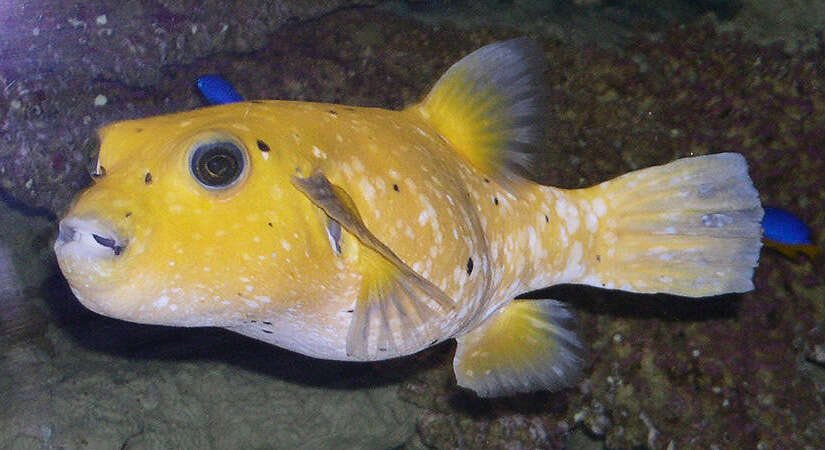
Arothron meleagris (Lacepède, 1798) ('opu hue)
Aetobatus narinari (Euphrasen, 1790) (Bishop ray)
Large groups of spotted eagle rays may be seen outside of the breeding season. These rays swim close to the surface and can occasionally be seen jumping clear out of the water (known as 'breaching') . Females give birth to...
Read More
Read More
Share on Social Networks
- Facebook:

personalize your shared text as well as its destination (wall, page...) or send as a private message to a friend
- Twitter: Tweet personalize your tweet
- Google Plus:
Direct link to this dive
- Long link:
- Short link:


 We are participating today in the startup contest Techcrunch Disrupt. Support Diveboard by voting for us!
























































































Paulo is a great guide, local to the area and very knowledgeable. That goes for William, too. But Paulo said that Cousin Rock is his favorite dive site, so that got us excited. The water is colder here: expected low-to-mid 70's, so I claimed my 3mm back from Dennis. (The hooded vest, however, was not going to be put back on!) Jen did the same with her 5mm, Dennis traded back up with James, and so on. Cousin Rock is a small island just off the coast on the northeast Isla Santiago. The island is triangular in size, and resembles something that may have been capsized--as if the island lay flat at one point, and then just tipped up to expose it's underside. The side facing west was smooth and pitched at a 45-degree angle, while the east side was a jagged cliff. We were told we would dive the jagged side, and under water was much the same with alot of coveys where animals liked to hide, sleep and hunt. Under the water, at its base, the island flattened and spread out a bit before dropping deep. We would remain near the rock and over the base. Expect currents, and stay with the group: we would all come up together. Check! Sea lions! Several of them diving off the cliff above us, down and along one of the crevices where they were almost completely obscured by a large school of small, orange cardinal fish. These guys may not do much besides sleep and breed on land, but they are quick and agile underwater. They were playing and having a good time, but never approached us too closely. We swam along that ledge, which gently sloped deeper from around 30' at the start. Starfish were abundant here as they were on our cold-water dives earlier in the week: at least three species were present including the chocolate-chip starfish, blue starfish, . Below a school of razor surgeonfish tucked away in a crevice was a resting white-tipped reef shark, about four or five feet in length. (Check #4 species of sharks in the Galapagos off my list.) Paulo pointed out a large stone scorpionfish on the edge of a rock, just about where I would have placed my hands. (Thanks Paulo!) We were now at about 50' when the wall gave way to a large shelf, and on top was the largest group of sea turtles I have ever seen in one place! Dennis counted eight resting, and another eight swimming nearby. Underneath, Jen pointed to a small, softball sized critter--I don't know whether it was an anemone, coral, or something completely different. It was very symetrical in shape, white, and made up of protruding tubes that completely covered its surface. The openings of the tubes would open and close, and the tubes would wave as Jen forced water over it by waving her hand. A yellow pufferfish had wedged itself into a rock crevice, where you could only see it's face sticking out. It looked like a big, yellow smiley face--the kind that was inspired by Forrest Gump in that movie, Forrest Gump. The comic relief of the dive. The turtles, still swimming about above, seemed to not like us intruding on what can only be described as an orgy: several males were present; you can tell by the length of their tales. I don't know for sure what was going on, but we very well may have depleted the future population by a few turtles. Or at least delayed it a bit. I noticed a large school of pelican barracuda above the turtles, when our attention was turned away. Out over the blue away from the shelf swam a school of a dozen or so eagle rays! At this point, we had come around the point of the rock, and the jagged edges gave way to a smoother surface, and a tad more current (nothing serious, though, or even much to kick against). Our dive had come to an end, and we ascended to our safety stop. I swam over a couple of resting white-tipped sharks and was tempted to dip down to them, but remembered that we needed to stay together as a group here, so we wouldn't scatter on the surface.
When we got back onto the boat, we were told that there were penguins spotted not far away near Pinnacle Rock on Bartolome Island, a short swim from Isla Santiago on its eastern side, but a long panga ride from our boat at Cousin Rock. So we had a choice: we could go as a group to dive our last dive at Cousin Rock, or we could take a panga over to Pinnacle for a chance to see penguins (or A penguin, as it turned out). About half chose to dive, while the other half--me included--chose to see a penguin in its natural habitat. I don't believe anyone in either group regretted their decision: I personally started having ear problems after a reverse squeeze at Wolf Island, and was progressively getting worse with each dive. Besides, a chance to see a penguin or two in their natural habitat and this far north was something I just couldn't miss. Pinnacle Rock and Play Dorada (Golden Beach) on Bartolome is beautiful. The landscape is stark, with only a patch of lava cactus and a few other hardy plants growing on its southern end. This was a young island that hadn't been burdoned with vegetation. Along the shoreline were hundreds of bright red crabs; a variety we had seen plenty of times, but not quite this close, nor this much contrast against the black lava rock. Pablo spotted it first: up on a small ledge stood a very small Galapagos penguin. Endemic to these islands, they are small--about a foot tall--and the occupy the northernmost natural habitat for penguins in the world. We only saw a single animal, but it was worth it! He stood upright for a long while as our guide pointed out facts about the creature and the island itself. Finally, either tired of us or the hot sun, he stumbled down the rocks and splashed into the water, swimming straight for the panga, around the bow, and dipped under water and out-of-sight. Mission accomplished!
Meanwhile, the other group started on the opposite end of the island and made their way back to the same point. They said the sea lions were more abundant and much more playful this time around. They also saw a large school mobula rays and a few eagle rays. We returned to a happy boat, cleaned our gear, and got ready for our afternoon land excursion on Santa Cruz to see Galapagos tortoises.