


 Smmcdonald


 Costa Rica
-
Nº86
 Date: 2016-09-11 - 10:34
-
 Max Depth: 24.7m Duration: 32mins
Dive Location

- Surface interval:81 mins
- Temp: Surf 33°C Bottom 27°C
- Dive type : Recreational
- Visibility: Average Water: Salt
Specific gear used
- Weights: 4.5 kg
Recent Divers in Playa Hermosa, Guanacaste



Link to this spot:
- Spot:
- Country:
- Area:
- Body of water:
Dive Profile
- 1. Nitrox 31
- 10L Aluminium 201 → 25 bar
- Average depth: 14.9m
Data provided by EOL.org
Species Identified
Share on Social Networks
- Facebook:

personalize your shared text as well as its destination (wall, page...) or send as a private message to a friend
- Twitter: Tweet personalize your tweet
- Google Plus:
Direct link to this dive
- Long link:
- Short link:


 We are participating today in the startup contest Techcrunch Disrupt. Support Diveboard by voting for us!
























































































Costa Rica is a beautiful country! Friendly people, natural beauty, and plenty of diving! Today's dive would mark my first dive in the Pacific Ocean and I was itching to go! Since we arrived I have been admiring the rocky outcrops just off in the distance from our hotel room, and now we would be venturing out beyond the for our first day of diving.
We met on the shore just downhill from our resort hotel. There we were greeted by the Rocket Frog Divers crew in a small motor boat. We would use this boat to transfer to the larger catamaran in two groups. Jen and I were in the first group, and soon we were joined on board the larger boat by the second.
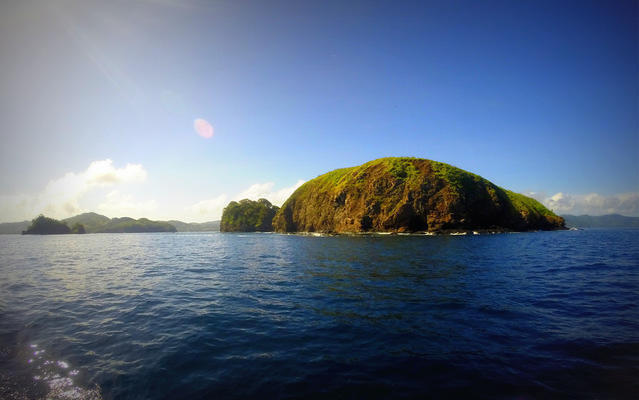
As we passed the outcrops, I noticed something rather strange: the two largest rocks, barely separated by a spit of ocean, had two completely different ecosystems. The vegetation on one was short and clung to the rock like carpet. Next to it, and a bit smaller, the other rock displayed a large clump of trees at its crown. I found this to be very odd considering the close proximity of the two islands.
Just offshore and a bit further beyond the rocks, we arrived at our first dive destination. The boat has two entrances: one on either side just aft of the midpoint. These would allow us to giant stride in two-at-a-time. There were also two entries off of the stern, one on each transom.
The water was warmer than I expected and I was glad I hadn't worried with my wetsuit. The visibility was decent, at about 20' people started to fade and the water was a bit green. Near the bottom, we were met with large boulder outcrops with algae and coral (?) growth. Vastly different from the Caribbean we're used to, the environment was a bit strange at first. In fact, it reminded more of the waters off of our NC coast than the tropics.
Jen immediately found an octopus that, despite her pointing him out to me, I did not see. I wasn't sure what she had found, and I was focused on some shells--one in particular was a bright pink/red. Only later when our dive guide pointed out the same octopus did I realize what she had found.
After the octopus, our guide--who we were told was great at finding all sorts of macro life, and who did not disappoint in this regard--found a small clump of orange coral. Among the fingers of the coral was a seahorse of the same exact color. No bigger than 2" in length--I would guess--he strayed a little bit away from his home for us to get a better look. The first octopus and first seahorse I have seen "in the wild", and we were just getting started.
I soon realized that, while some of the fish looked very familiar, many I had never seen before. I was fixated on a dark blue puffer with white spots. This fish was so different in color--not to mention I don't see puffers this large often--I spent several minutes filming him. But soon after, I realized that they were everywhere! Most were blue-black like the first one I saw, while others were yellow-gold, and mixed yellow with black splotches and white undersides. I later learned that these were guineafowl puffers (for obvious reasons) in various color forms. Among the puffers were several of their porcupine fish cousins.
There were schools of grunts or perches--or some other fish that seemed to be similar to those found in the Caribbean and south Florida. There was also a very long cornetfish which at first glance I thought was a trumpetfish, and then noticed something wasn't quite right. This fish was more slender than a trumpetfish.
It also had two pairs of dorsal/anal fins set far back on its body, the first of which were much smaller than those of a trumpetfish. Beyond the second pair protruded a long whip-like tail, breaking the 'caudal' fin in two.
We swam among other curiosities, including a round stingray and several very large moray eels. We were all talking about the abundance and size of these eels back on the boat. We see them often in Key Largo and surrounding seas, but never as many as we saw today.
Back onboard, we headed off to our next dive just a short distance away, Argentina Point. The only disappointment I heard was the short dive time, but I figured this was a 'test' dive to see how we'd do, and it was successful all the same.