


 Smmcdonald


 Ecuador

-
Nº116
 Date: 2018-06-14 - 13:49
-
 Max Depth: 28.4m Duration: 43mins
Pictures

No pictures for this dive
- Temp: Surf 30°C Bottom 27°C
- Dive type : Recreational
- Visibility: Good Water: Salt
Specific gear used
- Weights: 7.3 kg
Dive reviews
| Overall review | ||
| Dive difficulty | ||
| Marine life quality |
Recent Divers in Darwin Island

Dive Shop & Buddies
 Dive with William Saltos from Explorer Ventures Liveaboard Diving
 Dive buddies:
Jennifer McDonald,
James Shawver,
Cathy Dingman,
Tracy Newton,
Dennis Zullig,
Johnny Kerr,
John Dingman

Link to this spot:
- Spot:
- Country:
- Area:
- Body of water:
Dive Profile
- 1. Nitrox 32
- 12L Aluminium 202 → 26 bar
- Average depth: 18.3m
Data provided by EOL.org



Species Identified
Lutjanus viridis (Valenciennes, 1846) (Blue-and-gold snapper)
Epinephelus labriformis (Jenyns, 1840) (cabrilla)
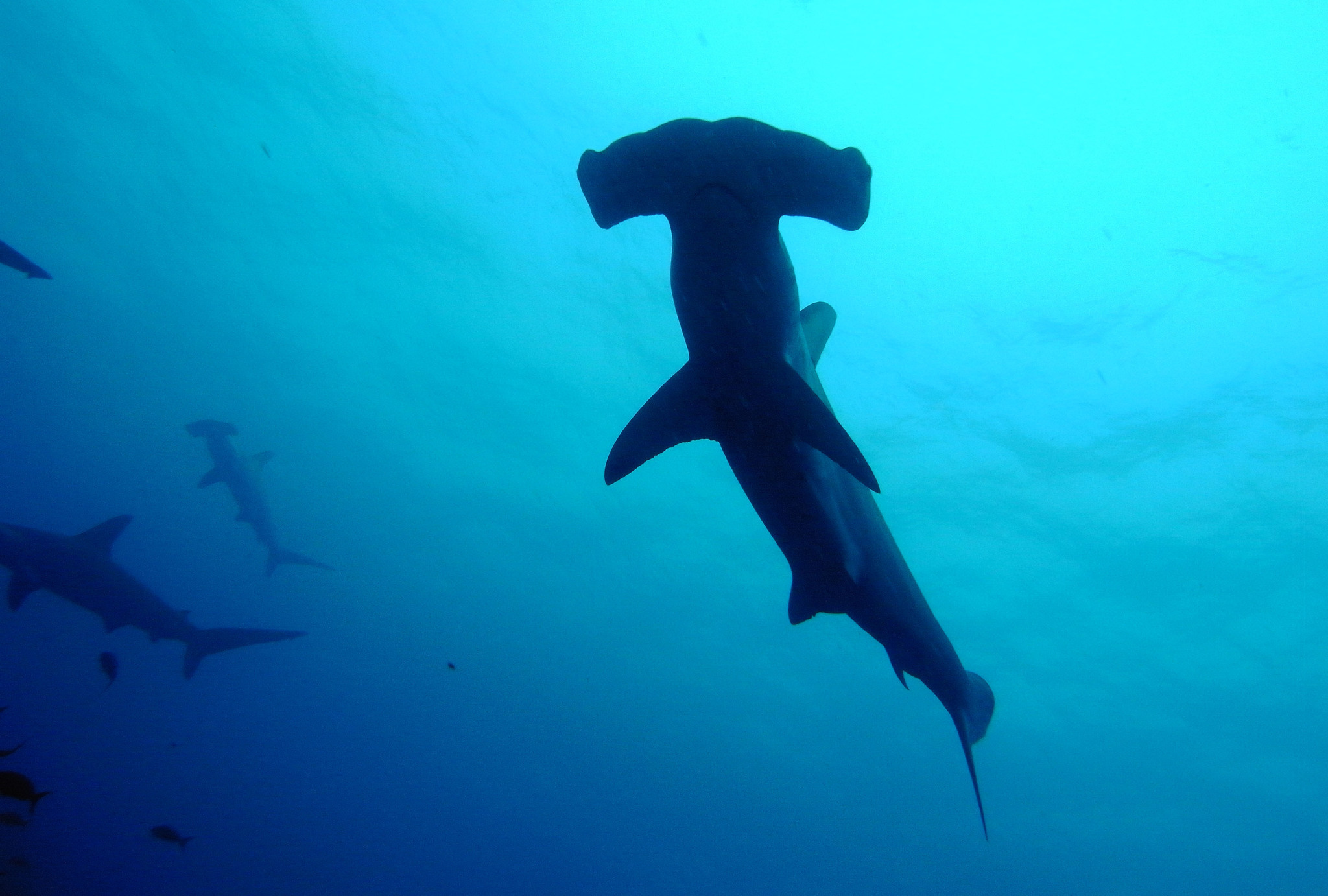
Sphyrna lewini (Griffith and Smith, 1834) (scalloped hammerhead)
Forming impressively large schools, female scalloped hammerheads gather in the Gulf of California during the day, around underwater mountains known as seamounts, where they perform a wide range of poorly-understood behavio...
Read More
Read More
Carcharhinus galapagensis (Snodgrass and Heller, 1905) (Galapagos shark)
Share on Social Networks
- Facebook:

personalize your shared text as well as its destination (wall, page...) or send as a private message to a friend
- Twitter: Tweet personalize your tweet
- Google Plus:
Direct link to this dive
- Long link:
- Short link:


 We are participating today in the startup contest Techcrunch Disrupt. Support Diveboard by voting for us!
























































































Our first dive at Darwin Arch; sunny skies and warm. This was a slow drift dive, mostly skimming above boulders along the base of the arch. Most times, the current runs from the arch toward the island, but today it was reversed so we slowly drifted along the rock clockwise. A lot of the fish here are the same as at Wolf Island, though in fewer supply--at least during this dive. Shortly into our dive I came across a small school of barberfish picking at the barnacle-covered rocks. Above was a school of blue-and-gold snapper, creolefish and rainbow wrasse. Along the bottom hiding beside a rock I found a flag cabrilla (identified later while reviewing video footage). Nearby was a sea urchin about the size of a softball. I took notice of this particular urchin as it was different from the long-spined blue urchins and the pencil urchins that were abundant at Wolf Island and, especially, Punta Carrion and in Puerto Basquerizo Harbor. I identified this specimen later as a white urchin: the short, sharp spines of white make a stark contrast against it's dark body. (This species of urchin has been researched extensively due to its potential medical benefits.) At one point, we settled onto a ledge at a drop-off where a mexican hogfish took an interest in Jen. Apparently, the fish have learned that divers often break off pieces of barnacles when anchored into the rocks to stay stationary and avoid being tossed by the surge. This particular fish swam circles around and under Jen, stopping at her hands and watching intently as she moved them along the boulders. Despite her not breaking any barnacles, the fish stayed with her for a long time during the dive, presumably hoping for an easy snack. Another interesting fish to note was the leather bass. I had scene several of these fish over the past few days. The leather bass is about foot or two long. They aren't particularly colorful, but their patterns are unusual. their bodies are crossed with wide vertical bars of grey and olive, and they are covered with small white blotches--not quite dots--over their entire surface. Their fins are all edged in bright yellow, almost chartreuse. A large school of pacific creole fish swam against the current in front of us, as well as a few hammerheads and one or two galapagos sharks. But no schools as large as we saw at Wolf Island earlier today. Our ascent took us over the blue, away from Darwin Arch. During our safety stop, we were accompanied by a small, tightly packed school of jacks, possibly bigeye trevally, and a green sea turtle. We surfaced near the arch on the opposite side from the island: blue skies and puffy white clouds above. William seemed disappointed in the lack of hammerheads and galapagos sharks, or maybe he was hoping for something bigger: another whale shark.. Nonetheless, it was a beautiful and enjoyable dive, and being this close to Darwin Arch was a bit surreal.