


 Smmcdonald

 Saint Lucia
-
Nº143
 Date: 2019-07-05 - 08:25
-
 Max Depth: 20.1m Duration: 41mins
Pictures

No pictures for this dive
- Temp: Surf 29°C Bottom 27°C
- Dive type : Recreational, Wreck
- Visibility: Good Water: Salt
Recent Divers in Anse La Raye
Recent Pictures in Anse La Raye
Dive Shop & Buddies
 Dive with Errol from Anse Chastanet Scuba St Lucia
 Dive buddies:
Jennifer McDonald
Dive buddies:
Jennifer McDonald

Link to this spot:
- Spot:
- Country:
- Area:
- Body of water:
Dive Profile
- 1. Air
- 12L Aluminium 208 → 14 bar
- Average depth: 14.7m
Data provided by EOL.org
Species Identified
Share on Social Networks
- Facebook:

personalize your shared text as well as its destination (wall, page...) or send as a private message to a friend
- Twitter: Tweet personalize your tweet
- Google Plus:
Direct link to this dive
- Long link:
- Short link:


 We are participating today in the startup contest Techcrunch Disrupt. Support Diveboard by voting for us!
























































































On our last day, Jen and I switched guides with Garland and Lilith. Errol would be guiding us on the morning dives, although the first was more-or-less a large group dive. Errol is a large man and soft spoken. He is the most experienced of the divers at SCUBA St. Lucia, with 20+ years as an instructor under his belt.
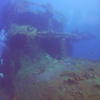
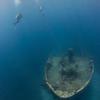
The Lesleen M is a 165-foot freighter sunk in 1986 as part of an artificial reef program. She sits upright on a flat sandy bottom at depth of 65' in the Bay of Anse Cochon. Penetration into the wreck is discouraged as the starboard side wall is starting to cave in. However, the center hull of the ship is wide and open from nearly the bow to the stern, and makes for good cover from the current. Besides the dives on Anse Chastanet Reef, this would be the only non-drift dive of the week. We sauntered down the buoy line which is tied off near the bow, and made our way down the port side of the ship. I was the first down the line and was greeted by a pair of queen angels before they scurried off for cover.
The wreck is covered in hard and soft corals, sponges and hydroids. Sea fan black corals protruded from the sides of the wreck, littered with dozens of brittle stars. At the bow of the ship, I captured a Venus's girdle on video; several comb jellies like this one were spotted during the night dives, especially. But my biggest surprise of the dive came next: on the starboard side near the bow was a large patch of garden eels! The largest colony I have seen outside of the 'Garden Eel' dive in Hawaii. Very shy, they would dip down into their borrows as I approached them, and quickly reemerge after I passed. Several arrow crabs were spotted on and near the wreck, but one was rather notable for being the largest I have seen. I do not know if there are varieties of arrow crabs found in the Caribbean, but this one had larger claws that were close in colour to the rest of its body (instead of the bright blue I have noticed on others). Other than these anomalies, there was no other distinction that would have set it apart from the arrow crabs observed on this and other dives.
Reaching the bow of the boat with plenty of air left, I decided to check out the large cargo hold. After awhile, not seeing much, I ventured back to the starboard side of the ship near the bow to check out the garden eels again. While there, I caught site of several sand tilefish. Interestingly enough, I didn't pay much attention to them until I played back my video later. These fish are apparently common throughout the Caribbean, even making their way up to Florida, the Gulf of Mexico and North Carolina. Oddly enough, I've never recorded seeing them until now, despite their odd shape and large size. I'm pretty sure I've even eaten one of these fish!
A small school of almaco jack swam past as I made my way up current and turned for a quick pass over the eels. This got me the closest footage of them, allowing me to scoot across more quickly and not giving them as much time to withdraw into their borrows. I noticed Myra doing something similar, entertained by them as much as I was. After a couple of passes, I was ready for a rest and signaled to Jen that I was going to swim up and over the starboard side and into the wreck to shield myself from the current. Keniass was there as well, hanging out near the bottom and striking poses as soon as he noticed my camera. We both ascended up a bit and peered over the side of the wreck. That's when one of our funniest moments happened: Luke had buddied up with Dave, as Marc and Myra had already started back up the line. Dave motioned for Luke to check his air, and, I suppose, the query was answered. But what we saw was Luke hitting his fist into his hand twice, and then giving him the 'two' sign. He did this twice, and as Keniass and I looked back at each other, it was apparent that neither of us knew whether he had 1200 PSI, or 200! We both immediately swam over and down to Luke and checked his gauge. It turned out he had 1100 PSI. Back on the boat, he told us he was playing rock-paper-scissors and was almost immediately surrounded! Well, at least we were paying attention!
We motored over to the shoreline a short distance away where we took our surface interval on Anse Cochon Beach. We were met by a very wet and friendly pup, who hung out with us for the duration of our interval. One of the boat crew found an old soccer ball and commenced playing on the beach. Up on the hillside was a resort; below were several vendors setting up to sell various trinkets. Heading back toward the boat, we heard a loud cheer come from three of our divers near the tree-line. Apparently, Alison had given her new learned skill of breaking open a coconut with her bare hands a try, and was successful! She delighted in sharing her treasure with the rest of us before we all climbed back on the boat and headed a short distance out to our next dive.