


 Smmcdonald


 Costa Rica
-
Nº87
 Date: 2016-09-11 - 12:28
-
 Max Depth: 23.8m Duration: 41mins
Dive Location

- Surface interval:81 mins
- Temp: Surf 33°C Bottom 27°C
- Dive type : Recreational
- Visibility: Average Water: Salt
Specific gear used
- Weights: 4.5 kg
Recent Divers in Cocos Playa CS
Recent Pictures in Cocos Playa CS

Link to this spot:
- Spot:
- Country:
- Area:
- Body of water:
Dive Profile
- 1. Nitrox 31
- 10L Aluminium 208 → 25 bar
- Average depth: 10.9m
Data provided by EOL.org
Species Identified
Share on Social Networks
- Facebook:

personalize your shared text as well as its destination (wall, page...) or send as a private message to a friend
- Twitter: Tweet personalize your tweet
- Google Plus:
Direct link to this dive
- Long link:
- Short link:


 We are participating today in the startup contest Techcrunch Disrupt. Support Diveboard by voting for us!
























































































Our second dive was a very short distance from our first, and still just off of the islands near the point that separates Bahia Hermosa and Bahia Coco. (I later found out that these islands are named Isla Montosa and Islas Pelonas. It was the latter islands we were diving near.) Our dive guide found a frogfish on the underside of an overhand that, though orange in color, blended in with the rock remarkably well. I'm not sure of the species, and the water clarity and low light did not allow pictures clear enough to determine on later observation. However, there are only 5 species that inhabit this area, and the large size and lack of a spot near the tail makes me think that it was a Giant Frogfish (Antennarius commerson). Nevertheless, it was the first frogfish I have ever seen, and thus was quite exciting.
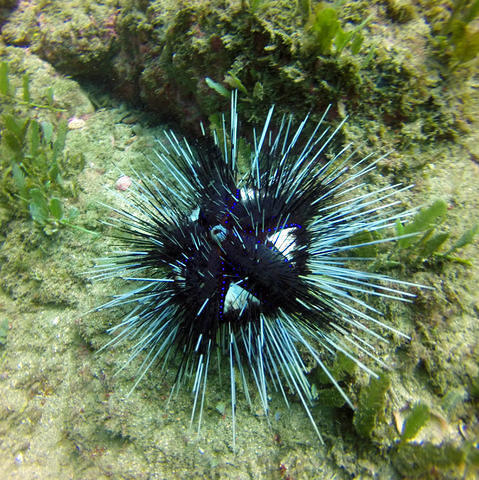
I noticed a few Mexican hogfish: these fish closely resemble the Spanish hogfish in shape, but with different coloration. The ones I observed were covered in pale scales with dark borders, darker stripes from the mouth and eye areas that extended along their bodies to their tails and a large yellow vertical stripe across the center of it's body. The dorsal, anal and caudal fins were edged in blue. Another new fish to me was the blacknosed butterflyfish (Johnrandallia nigrirostris). I saw a solitary one midway through the dive, and later was greeted by a school of 2 or so dozen. And many echinoderms were present, including several large, colorful urchins. Many of these were decorated with long white spins, ringed in brown/black stripes at their base. The body of the urchin was cream with a dark bluish-black star radiating from its center. Where the spines rose from the body, many small but brilliant, purple and blue neon dots outlined their base creating a pedal-like design within the star pattern.
The highlight of our dive was when our guide--ever vigilant in search of macro life--found two mantis shrimp hiding out under a small rock. I believe the called them clown shrimp, and if they were not, then they should be! (Another name for these creatures is Harlequin shrimp.) Beautiful specimens no more than an inch in length. They were cream to pale orange in color, with large reddish-brown spots all over their bodies.
Toward the end of our dive, we ascended to our safety stop among a large rubble pile. There was a very large school of jacks (maybe trevally?) just above us, and these were accompanied by many large king angelfish (Holacanthus passer), which created a very marked contrast with the silvery jacks. A few sergeant majors and butterfly fish were present, but kept lower in the water column. Smaller rainbow wrasse, and giant damselfish (Microspathodon dorsalis) stayed closer near the rocks. We stayed in this spot during our safety stop in a surge that rocked us back-and-forth several feet. It was quite fun once you got the hang of it (and thus stopped fighting it), however at least one of our companions did not agree.
We came up a little ways from the catamaran but close enough to comfortably kick back to the ladders. Unfortunately, we were not given a tag line as we had requested earlier, so getting everyone onboard took a little longer than usual. All-in-all, another beautiful dive full of first experiences is in the books!
A third dive was planned for some of the group, while the rest of us opted for a jungle river tour instead. About a half-hour drive away, we arrived to a muddy river that we seemed to have all to ourselves. The morning had been busier, and the afternoon showers warded off most tourists, so we had the whole boat--and river--to ourselves! Along the river we saw large crocodiles, small bats, howler monkeys and white-face monkeys, as well as several species of birds and some of the largest grasshoppers I've ever seen! Since I was a child, I have always wanted to see a basilisk running across the water. Well, I didn't get to see one run, but I did observe a few basking in the sun. Our guide pointed out that the locals refer to them as "Jesus lizards", given their super-abilities to "walk on water". This he said with a smile, common to the natives here. They are proud of their country and the natural resources it entails, and rightfully so. And they seem genuinely jovial.
The highlight was when a family of white faced monkeys climbed down into the boat and decided to check us out. We were warned to hold tight to anything we didn't want 'stolen' by these little thieves, but they behaved themselves, content with climbing around on us and sitting on our heads instead!
The rain had let up by the time we headed back. Our guide had spotted a sloth hiding in a distant tree over a creek on the way in, and we stopped again to see if we could get a better look. It was there--in the fork of a tree--but only a faint white spot on its back and a slight movement of the head hinted that the 'clump' was indeed a sloth. (And apparently the tree itself: the three-toed sloths apparently prefer to dwell in a particular species of tree, and usually over or near water.)
The little narrow streets, mostly of packed dirt, were flooded and kids were playing in them as we drove along the countryside. The sun was setting and cast a beautiful pink hue to the rain-soaked clouds along a distant ridgeline. The fields were green, and everyone was smiling as we rode on. We were then told that the past few years had been unseasonably dry, and the rain was very welcomed as many were worried about losing their livelihoods. I didn't need another reason to be glad of the rain--it just seemed natural and added to the beauty of the jungle. But indeed, this was a great reason to enjoy it even more.