


 Smmcdonald


 Costa Rica
-
Nº92
 Date: 2016-09-13 - 12:41
-
 Max Depth: 22.3m Duration: 47mins
Dive Location

- Temp: Surf 35°C Bottom 25°C
- Dive type : Recreational
- Visibility: Average Water: Salt
Specific gear used
- Weights: 4.5 kg
Recent Divers in Isla Catalinas

Link to this spot:
- Spot:
- Country:
- Area:
- Body of water:
Dive Profile
- 1. Nitrox 31
- 12L Aluminium 204 → 23 bar
- Average depth: 12.5m
Data provided by EOL.org
Species Identified
Share on Social Networks
- Facebook:

personalize your shared text as well as its destination (wall, page...) or send as a private message to a friend
- Twitter: Tweet personalize your tweet
- Google Plus:
Direct link to this dive
- Long link:
- Short link:


 We are participating today in the startup contest Techcrunch Disrupt. Support Diveboard by voting for us!
























































































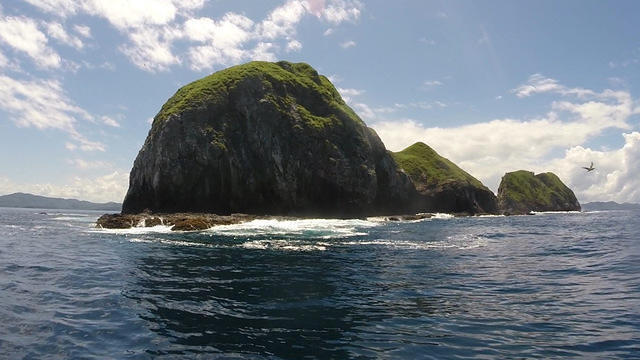
We spent our surface interval circumnavigating the islands. Again, I was surprised to see the difference in vegetation on two islands in such close proximity and relative aspect. The southern-most island was pinnical in shape, and was crowned in large cacti that towered above the densely packed green vegetation that held tightly to the rocky surface. The northernmost island was larger in size, and about the same height, but was without the large cacti. From the top, the terrain sloped down steeply before it gave way to cliffs. The cliffs were pocked with caves at about sea level, with several large ones rising up to considerable heights. Between the two islands was a narrow, rocky channel, just large enough for a small fishing boat to navigate, but not on a day with even moderate seas. Rounding the north end of the island, we reached our second dive site, "La Pared" (The Wall) near another flat rocky outcrop. Waves crashed against the boulders at times covering the entire surface. There would be surge near those rocks, and probably on our dive.
We dove in and were greeted with a familiar scene of boulders and sea life. I found a sea star similar to our blue star friends, but this one with a slightly different variation in pattern color The body was olive green. Tows of stripes made up of yellow-green spots ran down both sides of the arms. spots of teh same color were present on the body as well. The spots were absent along the ridges of the arms. This turned out indeed to be a cousin of the blue/tan star: Pharia pyramidata, commonly known as the yellow spotted star, or pyramid starfish.
Another familiar, yet different looking creature was hanging out between boulders nearby. This fish had the same shape, features and patterns as our mystery 'grasby' fish I found on our "Tiburones" dive yesterday. This one, however, had a much paler body and the spots (or more like splotches) were double-lined in dark green and light blue. Also I noticed that the spots were really more like rings, kind of like those of a leopard. This fish was just as skiddish as the other I found yesterday, but I managed to get a decent shot for possible idenfication later. (And indeed it did: this is a giant hawkfish (Cirrhitus rivulatus). Apparently, this coloration is more typical than of those I saw yesterday. Mystery solved!)
As we rounded the outcrop, we came upon a large bait ball. This one rose up and formed a large archway over the sandy sea bottom. We kind of played around with this bait ball, each diver taking his or her turn swimming through a portion while the others watched the group split, turn and then reform into another 'blob'. We did this for several minutes, fascinated by their uniform movements, before moving on.
Next we saw an octopus, this time in the opening and being harassed by a damselfish. He was nearly the same color and texture as the sea floor and boulders of his environment. When we got close, he scurried over a foot or so and changed color to more of a blue color. He seemed more annoyed by the damselfish than by us, whipping one of his tenticals at it several times.
Once again, we could hear whales in the distance. A low-to-high pitch whooping, occasionally followed by a deep "thwump". We were told the they made the latter noise when they surfaced to exhale.
At the end of our dive, as we hung out on the finger reel for our safety stop, two devil rays approached us. I had a great shot as the first came right toward me and then up and over. Unfortunately, my camera would not turn on, and when it did, it was on camera mode. It was a beautiful site, but unfortunately, was not caught on video. Two dives with devil rays, and not a single decent shot! Oh well, something to come back for.
The guide (Scott) handed the finger reel off to Jen for the safety stop, as he dove back down toward the bottom. When he ascended a little later, his nose was bloody. He told us that something--I forget exactly what--had come loose and he dove down to retreive it. Because of the depth, he had to redo his ascent. The bloody nose likely came from descending so quickly.
Back on the boat, we headed toward Playa Hermosa, stopping along the way to dive our last dive of the day, and the last for our trip to Costa Rica.